In brief
- Problem
- Rubidium quantum memories work at 795 nm. Optical fiber works at telecom wavelengths. An external frequency converter can bridge the mismatch.
- Idea
- A far-detuned laser creates a dressed state that a 795 nm transition and a 1324 nm transition both couple to. The result is one dark-state polariton with two photonic components.
- Result
- In a full six-level simulation of rubidium-87, light is stored and retrieved on all four in/out wavelength combinations.
- Status
- Theory and numerical simulation. Not yet an experiment.
The wavelength problem
A quantum network distributes entanglement using single photons. An unknown quantum state cannot be perfectly copied, so ordinary optical amplification cannot repair photon loss while preserving quantum information. Memory-based quantum repeaters instead use quantum memories: devices that absorb a photon, hold its state, and re-emit it on demand, so that separate segments of the network can be synchronized.[1][2]
Atomic ensembles are an established platform for optical quantum memory.[3] The catch is that an atom only talks to light at its own transition wavelengths. For the rubidium-87 D1 transition used here, that is 795 nm.[9] Telecom fiber offers low attenuation at longer wavelengths. For example, Corning specifies maximum losses of 0.32 dB/km at 1310 nm and 0.18 dB/km at 1550 nm for SMF-28 Ultra.[4]
A common solution is an external quantum frequency converter. Radnaev and colleagues demonstrated a memory interface using four-wave mixing in a separate cold-rubidium ensemble.[5] Van Leent and colleagues used a pumped nonlinear crystal to convert 780 nm photons to 1517 nm and entangle two atomic memories over up to 33 km of fiber.[6] Conversion adds an optical subsystem with finite efficiency and can introduce pump-induced noise that must be filtered.[6]
Our question: can the memory itself be the wavelength interface?
How an atomic memory stores light
The standard scheme uses three atomic levels: two long-lived ground states, |b⟩ and |c⟩, and one excited state |a⟩. Drawn as a level diagram it looks like the letter Λ, which is what it is called. The signal photon drives |b⟩ → |a⟩. A strong control laser drives |c⟩ → |a⟩.
With both fields on, the photon does not travel through the atoms as plain light. It travels as a dark-state polariton[7]: a single excitation that is part photon and part spin wave, where the spin wave is a coherence, a fixed phase relationship, between |b⟩ and |c⟩ shared across the whole ensemble. The control laser's intensity sets the ratio. Lower the control and the polariton becomes more spin wave, less light, and slows down. Switch it off smoothly and the light is gone. The state now sits entirely in the atoms. Switch the control back on and the photon comes out.[8]
The point to hold on to: the stored excitation lives in the ground states, and it has no optical wavelength. Wavelength only enters through the transition used to write it and the transition used to read it.
The obstacle: the telecom transition has no ground state
Rubidium-87 does have a telecom line, at 1324 nm. But it connects two excited states, 5P1/2 and 6S1/2. The lower one has a lifetime of about 27.7 ns,[9] so it cannot serve as a long-lived, initially populated ground state.
Two-color polaritons are known from "double-Λ" schemes, two Λ systems side by side.[10] In the double-Λ configuration analyzed there, both signal transitions start from the same ground state. Here the 795 nm transition starts in the ground state |b⟩ and the 1324 nm transition starts in the excited state |e⟩. The two signal transitions have no common lower state.
One polariton, two colors
In the far-detuned, weak-excitation limit, the theory gives a mode with suppressed population in the lossy excited states. It is one excitation with three parts: spin wave, 795 nm light, and 1324 nm light. The weight of each light component is set by classical control lasers: Ω for 795 nm, and the pair Ω1, Ω2 for 1324 nm.
That gives the whole protocol. Turn every control off and both light terms vanish: the group velocity goes to zero and the excitation is pure spin wave. Then choose the output. Turn on the dressing laser together with Ω and the spin wave leaves as 795 nm light. Turn on the dressing laser with Ω1 and Ω2 instead, and it leaves at 1324 nm. The readout wavelength is selected by which lasers you switch on.
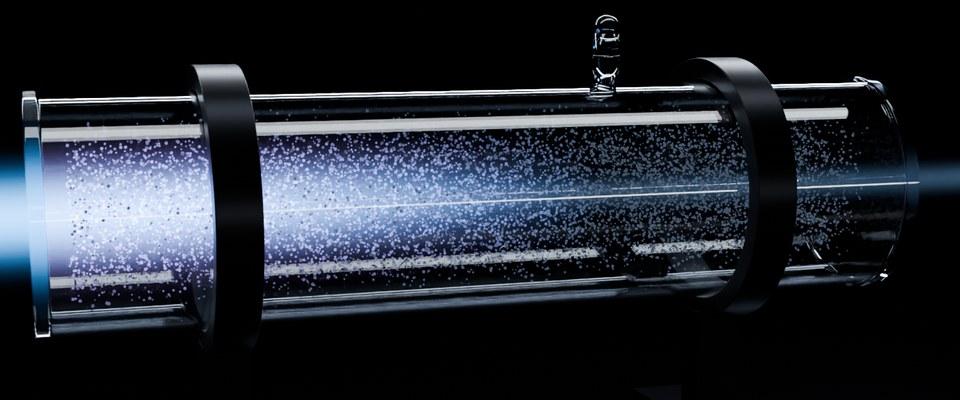
A 795 nm pulse enters, is compressed, and slows as the control is ramped down.
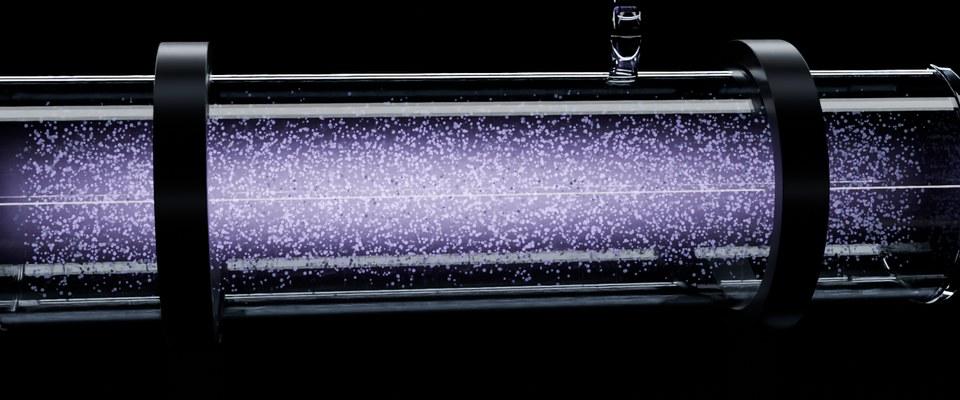
All fields off. The state is held as a ground-state spin wave.
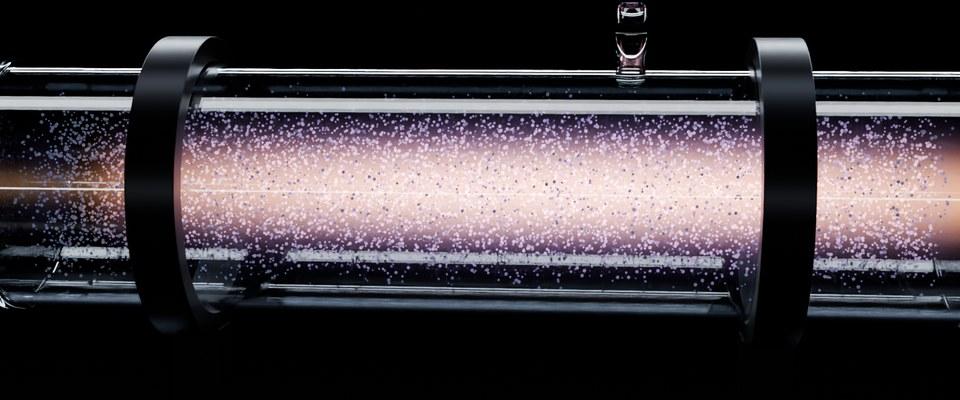
The telecom-side controls come on. The pulse leaves at 1324 nm.
Nothing here is a conversion stage bolted on after the memory. The wavelength change is part of the storage process.
Why it matters
- The memory becomes the telecom interface. One fewer conversion stage at every node of a network that will have many nodes.
- The output wavelength is reconfigurable. The same stored state can be read out at 795 nm for a local atomic device or at 1324 nm for the fiber, chosen at readout time by the control lasers.
- The construction is general. Using a dressed state to give two unrelated transitions a common level is not specific to rubidium. It suggests a route to other atoms and wavelength pairs, provided suitable levels and control fields can be found.
So far this is theory, checked against a full numerical simulation of the six-level atom, in which all four in/out wavelength combinations work. The simulations use weak classical probe fields and neglect ground-state decoherence during storage; they do not establish single-photon noise or fidelity. What comes next is the experiment, per-route optimization, and a noise measurement at the single-photon level.
References
- H. J. Kimble. The quantum internet. Nature 453, 1023–1030 (2008).
- N. Sangouard, C. Simon, H. de Riedmatten, and N. Gisin. Quantum repeaters based on atomic ensembles and linear optics. Reviews of Modern Physics 83, 33–80 (2011).
- A. I. Lvovsky, B. C. Sanders, and W. Tittel. Optical quantum memory. Nature Photonics 3, 706–714 (2009).
- Corning. SMF-28 Ultra Optical Fiber: Product Information, PI1424 (July 2025), p. 1. Maximum attenuation specifications.
- A. G. Radnaev, Y. O. Dudin, R. Zhao, H. H. Jen, S. D. Jenkins, A. Kuzmich, and T. A. B. Kennedy. A quantum memory with telecom-wavelength conversion. Nature Physics 6, 894–899 (2010).
- T. van Leent, M. Bock, F. Fertig, R. Garthoff, S. Eppelt, Y. Zhou, P. Malik, M. Seubert, T. Bauer, W. Rosenfeld, W. Zhang, C. Becher, and H. Weinfurter. Entangling single atoms over 33 km telecom fibre. Nature 607, 69–73 (2022).
- M. Fleischhauer and M. D. Lukin. Dark-State Polaritons in Electromagnetically Induced Transparency. Physical Review Letters 84, 5094–5097 (2000).
- D. F. Phillips, A. Fleischhauer, A. Mair, R. L. Walsworth, and M. D. Lukin. Storage of Light in Atomic Vapor. Physical Review Letters 86, 783–786 (2001).
- U. Volz and H. Schmoranzer. Precision lifetime measurements on alkali atoms and on helium by beam–gas–laser spectroscopy. Physica Scripta T65, 48–56 (1996). The 27.70(4) ns result is also tabulated and attributed to this work in D. A. Steck, Rubidium 87 D Line Data, revision 2.3.4 (August 8, 2025), §2.1.
- Y. D. Chong and M. Soljačić. Dark-state polaritons in single- and double-Λ media. Physical Review A 77, 013823 (2008).